
Quick answer
There is no "ranking" to check in AI search. Instead, measure three things for the prompts your customers actually type: whether ChatGPT, Claude, Perplexity, Gemini and Grok mention your brand, whether they cite your site as a source, and whether anyone visits after reading the answer. Run 10 to 20 real prompts across all five engines, score every answer on those three levels, write down which competitors show up instead of you, and fix the gaps in that order. By hand it takes about 30 minutes. Automated, it takes 2 to 3.
Web search is simple. You rank third for "best vitamin C serum". Search Console shows you impressions, position and click-through rate. One keyword, one page, one number.
AI search throws all of that out. There is no position. There are five engines instead of one. The same question gets a different answer depending on who asks, where they are, and what they said three messages ago. You can be the default recommendation on Gemini and not exist on ChatGPT, and nothing will tell you.
So most brands do one of two things. They ask ChatGPT about themselves once, feel good or bad, and move on. Or they look at referral traffic in analytics, see a tiny number, and decide AI search doesn't matter yet.
Both miss the point. This post is the written version of the audit I walk through in the video below, with the scoring framework, the tracking setup and the fix list.
Why can't you just check your AI search ranking?
Because the thing you would be ranking for doesn't exist. A ranking needs a fixed query and a fixed list. AI search has neither.
The query is a prompt, not a keyword. People don't ask ChatGPT for "vitamin C serum". They ask for "the best vitamin C serum for sensitive skin under $50 that doesn't contain fragrance". That is longer, more specific and far more valuable, and there are thousands of versions of it.
The answer depends on context. A conversation is a funnel. Question, answer, follow-up, answer, and somewhere in there your product shows up or it doesn't. Location, language, saved memory and everything said earlier in the thread all shift the response. Two people can type the identical prompt and get two different brand lists.
There are five engines, and they disagree. ChatGPT, Claude, Perplexity, Gemini and Grok each pull from different sources and weigh them differently. In the audit in the video, the same brand appeared in 4 of 10 answers on Grok and 0 of 10 on Claude.
Your Google rankings don't carry over. Ahrefs checked 15,000 prompts and found that only 12% of the URLs cited by ChatGPT, Gemini and Copilot rank in Google's top 10 for the same prompt.1 For ChatGPT's own search queries, the overlap drops to under 7%.2 Ranking well on Google is helpful, but it is not the same thing as being visible in AI.
So the unit of measurement changes. In SEO you track keywords and pages. In AI search you track prompts and citations: which prompts name you, and where the model says it got its information.
What are the three levels of AI visibility?
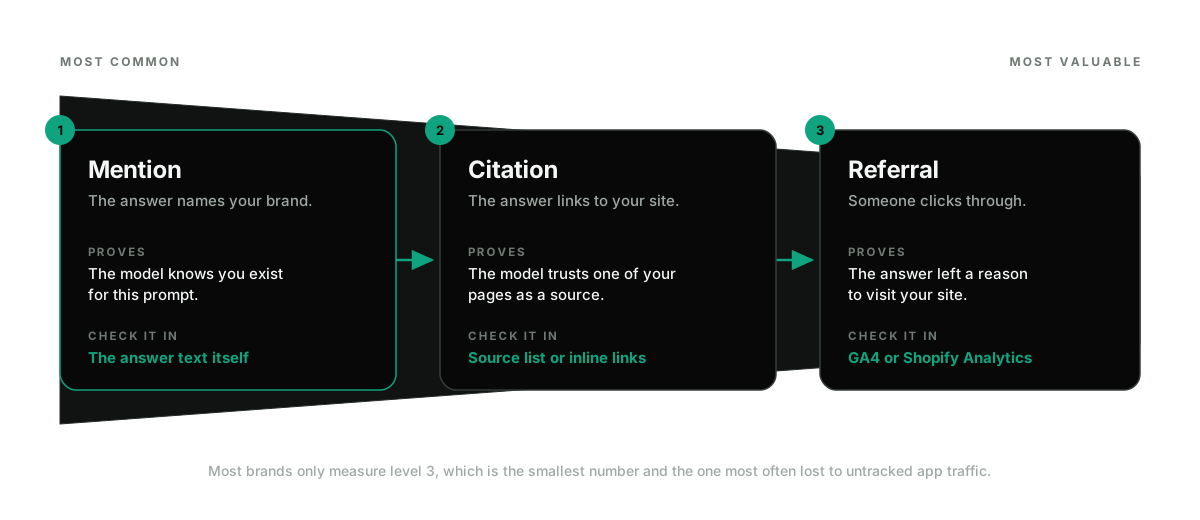
Every AI answer can do three things for your brand, and they are not the same thing. Score them separately.
Level 1: Mentions
Does the answer name your brand? That is a mention. It proves the model knows you exist for that prompt and considers you a plausible answer.
A mention with no link still matters. It puts your name in front of a buyer at the moment they are deciding, and it drives branded searches you will never trace back to AI. It is also the level that the strongest research points at. Across 75,000 brands, Ahrefs found that how often a brand is mentioned across the web is the single best predictor of whether it shows up in AI answers, at a correlation of 0.664. Backlinks came in at 0.218.3
Level 2: Citations
Does the answer link to your site as a source? That is a citation. It proves the model trusts one of your pages enough to send people to it and to put its own credibility behind it.
Citations are scarcer than mentions, and how scarce depends on the engine. In a Q3 2025 study of 118,000 answers, Perplexity averaged about 22 citations per answer while ChatGPT averaged 8.4 A citation slot on ChatGPT is a much harder seat to win.
Level 3: Referrals
Does someone click through after reading the answer? That is a referral, and it is the only one of the three you can see in your analytics.
Referral traffic is small in volume and high in intent. Similarweb puts ChatGPT-referred shoppers at an 11.4% conversion rate against 5.3% for organic search.5 Semrush found AI search visitors worth 4.4 times a traditional organic visitor, though that study looked at marketing topics, so treat it as directional for ecommerce.6
Here is the trap. Referral is the level most brands measure, and it is the smallest number, and it undercounts badly. Clicks from the ChatGPT and Perplexity mobile apps often arrive with no referrer at all and land in your "Direct" bucket. If you only look at level 3, you will conclude AI search is irrelevant while it is quietly naming your competitors to your customers all day.
A mention tells you the model knows you. A citation tells you it trusts you. A referral tells you it convinced someone. You need all three numbers, in that order.
How do you run an AI visibility audit by hand?
You need a spreadsheet, five browser tabs and about 30 minutes. Here is the process.
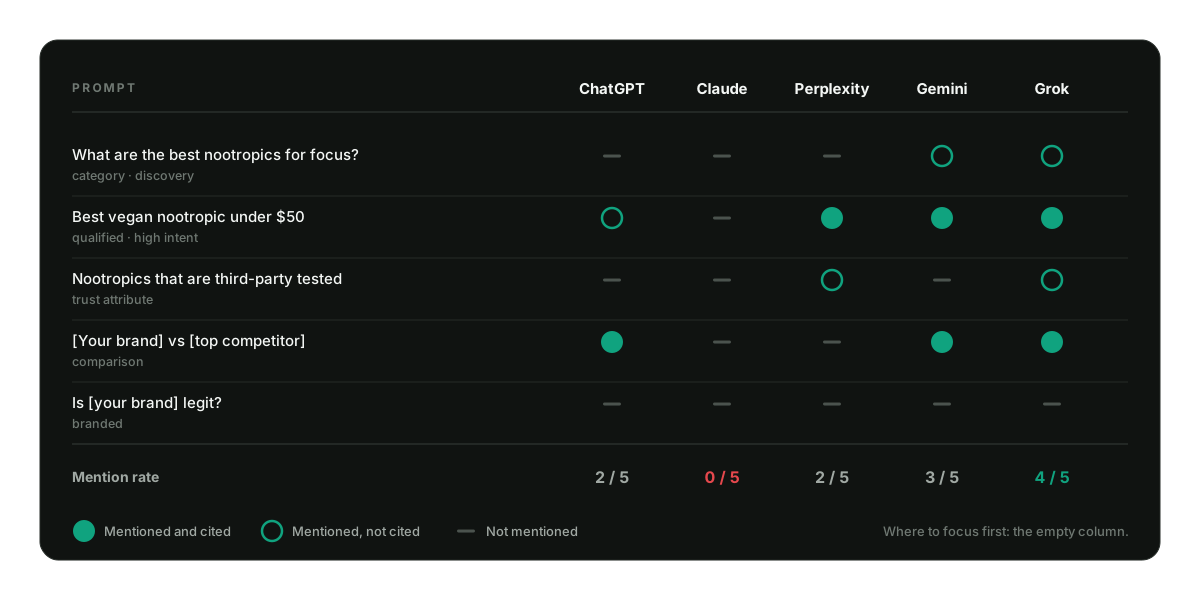
- Build a prompt set of 10 to 20 questions. Mix four kinds: category prompts ("best nootropics for focus"), qualified prompts ("vegan nootropic under $50 that's third-party tested"), comparison prompts ("[your brand] vs [competitor]") and branded prompts ("is [your brand] legit?"). Pull them from real places: your support inbox, your reviews, and Search Console queries rewritten as questions.
- Run every prompt on all five engines. ChatGPT, Claude, Perplexity, Gemini and Grok. Use a fresh, temporary chat with memory off so your own history doesn't skew the answer. Note where you are located; answers shift by region.
- Score each answer on the three levels. Mentioned: yes or no, and your position in the list of brands named. Cited: yes or no, and which URL. Then add two more columns: sentiment (how the model describes you) and accuracy (did it get your price, ingredients or claims right).
- Write down every competitor and every citation source. The competitors tell you who you are losing to. The sources tell you why. If a rival keeps getting cited via a Reddit thread or a review site, that site is your outreach list.
- Total it up per engine. Mention rate = mentions divided by (prompts × engines). Then break it out by engine so you can see the empty column.
- Check referrals last. Open GA4 or Shopify Analytics and look for the AI domains listed in the next section. Compare that number to your mention rate. The gap between them is the traffic you are leaving on the table.
The goal: own a prompt
You will never be in every answer, and you don't need to be. The goal is to own the specific, high-intent prompts that describe your core product, so that whenever someone asks that exact question, you are the recommendation. Think of it as a small plot of real estate in a very large market. A handful of owned prompts beats a thin presence across hundreds.
What does a real audit look like?
In the video, I run this on my own Shopify nootropics store using LinkGPT's AI Visibility feature. The app generated the prompt set, ran 10 prompts across all five engines, and returned the results in under three minutes.
The totals are fine for a crowded category. The breakdown is where the strategy lives:
- Claude never mentioned the brand. Not once, on any prompt. That is the first engine to target, because going from zero to something is the cheapest win on the board.
- Grok mentioned it most, on 4 of 10 prompts, and described it positively.
- Sentiment varied by engine. Gemini was very positive, ChatGPT and Perplexity neutral, Claude positive when it did discuss the brand (it just didn't recommend it).
- Reddit was a major citation source for prompts about third-party testing and clean-label ingredients. That is a direct signal about where the trust conversation is happening.
- Competitor citations pointed at specific pages. A rival was being cited from a review on a health publication. That single row turns into an outreach email: "You featured them. Here's why your readers should also know about us."
None of that is visible from a single ChatGPT session or from your analytics. It only shows up when you score the same prompts across engines and look at the pattern.
How do you check AI referral traffic in your analytics?
Level 3 is the one you can measure precisely, as long as you know where to look. AI engines mostly show up as referral traffic from a short list of domains:
| Engine | Referrer you'll see | Notes |
|---|---|---|
| ChatGPT | chatgpt.com (older: chat.openai.com) | Adds utm_source=chatgpt.com to cited links |
| Perplexity | perplexity.ai | Also www.perplexity.ai |
| Claude | claude.ai | Web app only; desktop app clicks may show as Direct |
| Gemini | gemini.google.com | |
| Grok | grok.com, x.com | Depends on whether the user is in the standalone app or X |
| Copilot | copilot.microsoft.com |
In GA4, open Reports → Acquisition → Traffic acquisition, switch the primary dimension to Session source, and search for those domains. Filter by source, not medium. ChatGPT appends utm_source=chatgpt.com to citation links but no utm_medium, so GA4 can't slot those sessions into a default channel and drops them into Unassigned.7 The fix is a custom channel group in Admin → Data display → Channel groups, placed above the default Referral rule, with a condition of Session source matches regex:
chatgpt\.com|chat\.openai\.com|perplexity\.ai|claude\.ai|gemini\.google\.com|grok\.com|copilot\.microsoft\.com
Two caveats
First, if chatgpt.com ever ended up on your referral exclusion list, GA4 is silently recording those visits as Direct. Second, mobile app clicks frequently strip the referrer entirely. Referral numbers are a floor, not a total. That is exactly why levels 1 and 2 matter.
Where do each engine's citations come from?
If your audit shows you are visible on one engine and missing on another, this is usually why. The engines don't read the same web.
Profound analyzed 30 million citations across ChatGPT, Google AI Overviews and Perplexity. The favourite sources barely overlap.8
 ChatGPT →
  Wikipedia47.9%
 Perplexity →
  Reddit46.7%
 Google AI Overviews → Reddit21.0%Google AI Overviews →
  YouTube18.8%
Fig. 3: ChatGPT leans on Wikipedia and structured reference content. Perplexity and Google lean on Reddit, and Google also cites YouTube heavily. · Source: Profound, 30M citations, Aug 2024 – Jun 2025
What that means in practice:
- ChatGPT rewards clear, factual, encyclopedic pages. Specific claims, specs, numbers, plain structure.
- Perplexity rewards fresh content and community discussion. If nobody is talking about you on Reddit, Perplexity has little to work with.
- Google AI Overviews and Gemini pull heavily from YouTube and from community sites. Ahrefs' follow-up study found YouTube mentions had the strongest correlation of any factor with AI visibility, at 0.737, across ChatGPT, AI Mode and AI Overviews.9
- Claude and Grok publish less data, so your own audit is the best signal you have. In my run, Grok's competitor list looked nothing like Gemini's.
An empty column on your scorecard is not a mystery. It usually means you have no presence in the places that engine trusts.
What do you fix when the audit comes back empty?
Match the symptom to the cause. Each row of your scorecard points at a different fix.
| What the audit shows | What it usually means | What to do |
|---|---|---|
| Not mentioned anywhere | The engines don't know you as an entity | Confirm AI crawlers can reach your site, publish llms.txt, rewrite vague product copy into specific facts, and earn third-party mentions |
| Mentioned, but never cited | They know you, but a better source exists | Lead each page with the answer, add real numbers and FAQs, add product and FAQ JSON-LD so the page is easy to quote |
| Visible on some engines, not others | A per-engine source gap | Reddit and community presence for Perplexity; reference-quality pages for ChatGPT; YouTube for Google and Gemini |
| Cited, but no referrals | The wrong page is being cited, or the answer is complete on its own | Make the cited page the converting page; include what the answer can't (price, availability, variants) |
| Cited, but the facts are wrong | Conflicting information across your web presence | Fix the source of the error, align every listing, add a visible "last updated" date |
| Negative sentiment on one engine | It is reading a bad review, an old thread or a rival's comparison | Find the specific source in your citation log and address it directly |
The content fixes have real evidence behind them. The Princeton team that coined the term "generative engine optimization" tested content changes against AI answers and found that adding statistics, quotations and citations to a page lifted its visibility in AI responses by up to 40%.10 Keyword stuffing, for the record, made things worse.
Fig. 4: Off-site brand signals beat classic link metrics. Being talked about matters more than being linked to. · Source: Ahrefs, 75,000 brands
One more thing to take from the video. Once you have the export, hand it to a strong model and ask it to draft the strategy. The audit tells you which prompts you lose, to whom, and from which sources. That is a very good brief.
If you run a Shopify store
The audit is identical. A few of the mechanics are Shopify-specific.
Referrals. In Shopify admin, go to Analytics → Reports and open Sessions by referrer. Filter for the domains in the table above. Shopify's attribution is simpler than GA4's, so ChatGPT's UTM quirk doesn't bite here, but the mobile-app blind spot still applies.
Crawler access. Good news first: Shopify's default robots.txt allows GPTBot, ClaudeBot, PerplexityBot and the other major AI crawlers. If your store blocks them, someone added a rule through the robots.txt.liquid template. Check yourstore.com/robots.txt, search for the bot names, and remove any Disallow: / under them.11 Note that this only controls open-web discovery. Product data sent to agentic storefronts such as ChatGPT Shopping flows through Shopify Catalog, which is a separate layer with its own settings.
Structured data. Your theme's product JSON-LD is what lets an engine quote price, availability and variants confidently. Check it with a validator. Missing or generic product schema is one of the most common reasons a store gets mentioned but never cited.
Automating the audit. This is what LinkGPT's AI Visibility feature does. It generates a prompt set from your catalog, runs every prompt across ChatGPT, Claude, Perplexity, Gemini and Grok, and returns mention rate, competitor positions, citations and sentiment per engine in 2 to 3 minutes. Run it weekly and you get a trend line instead of a snapshot, which is what you actually need, because single answers vary.
If you're a brand or creator without Shopify
Same three levels, same scorecard. Use GA4 for referrals and the custom channel group above. For the mention and citation layers, LinkGPT builds an AI Profile from the posts, pages, products and videos you already publish, tracks the prompts you care about across the five engines, and flags competitors, citations and sentiment. It then tells you the next best action, whether that is an FAQ to add, a video to connect, or a source to go earn.
How often should you re-run the audit?
Weekly for the prompts you are trying to own. Monthly at minimum for everything else.
The reason is variance. One run is a sample, not a truth. The same prompt can produce a different brand list on Tuesday than it did on Monday. What you want is the trend: is your mention rate on Claude moving from 0 to 2 to 4 out of 10 over six weeks? Is a competitor's citation source showing up less often since you earned a feature on the same site? That trend is your AI search ranking. It is the closest thing to one you will get.
Frequently asked questions
What is an AI visibility audit?
An AI visibility audit is a structured check of how AI engines respond to the prompts your customers ask. You run a fixed set of prompts across ChatGPT, Claude, Perplexity, Gemini and Grok and score each answer on whether it mentions your brand, cites your site and drives a visit, plus sentiment and accuracy. The output is a scorecard by engine and by prompt.
Can I see my ranking in ChatGPT?
Not as a position. ChatGPT doesn't have a results page or a fixed order. What you can measure is your mention rate (how often it names you across a set of prompts), where you sit in the list of brands it names, and whether it cites your site. Track those over time and you have the AI equivalent of a ranking.
Why does my brand show up in Gemini but not ChatGPT?
Because the engines read different sources. ChatGPT leans heavily on Wikipedia-style reference content and structured pages. Google's engines pull from YouTube, Reddit and community sites. Perplexity leans on Reddit and fresh content. If your presence is concentrated in one type of source, one engine will find you and another won't.
How many prompts should I track?
Start with 10 to 20. Cover category prompts, qualified prompts with price or attribute filters, comparison prompts against named competitors, and branded prompts about your own store. Ten prompts across five engines gives you 50 answers, which is enough to see a pattern without taking all afternoon.
Is AI referral traffic in GA4 accurate?
It is a floor, not a total. ChatGPT tags cited links with utm_source=chatgpt.com but no medium, so those sessions land in Unassigned unless you build a custom channel group. Clicks from mobile apps often arrive with no referrer and show as Direct. Use referral data to confirm the channel is real, not to size it.
Do I need a tool, or can I do this by hand?
You can do it by hand. Ten prompts across five engines takes about 30 minutes with a spreadsheet. The tool matters when you want to repeat it weekly, compare runs, and log every competitor and citation source without doing the data entry yourself. That is what LinkGPT's AI Visibility feature automates.
Sources
- Ahrefs, "Only 12% of AI Cited URLs Rank in Google's Top 10 for the Original Prompt": 15,000-prompt study; average citation overlap with Google's top 10 is 12%.
- Ahrefs, "Is ChatGPT Really Powered by Google? 118,931 Fan-Out Queries Analyzed": 6.82% of ChatGPT search results appear in Google's top 10.
- Ahrefs, "An Analysis of AI Overview Brand Visibility Factors (75K Brands Studied)": branded web mentions correlate 0.664 with AI Overview visibility vs 0.218 for backlinks; 26% of brands have zero AI Overview mentions.
- Qwairy, "Perplexity vs ChatGPT: AI Citation Study (Q3 2025)": 118,000+ answers; Perplexity averages 21.87 citations per answer, ChatGPT 7.92.
- Similarweb, "The Global State of Ecommerce 2025" via BusinessWire: 11.4% ChatGPT-referral conversion rate vs 5.3% for organic search.
- Semrush, "We Studied the Impact of AI Search on SEO Traffic": the average AI search visitor is worth 4.4× a traditional organic visitor by conversion rate, based on 500+ digital marketing topics.
- SearchPilot, "How does AI traffic show up in analytics?": referrer reference by platform;
utm_source=chatgpt.comwithoututm_mediumlands in Unassigned in GA4's default grouping. - Profound, "AI Platform Citation Patterns": 30 million citations, Aug 2024 – Jun 2025; Wikipedia is 47.9% of ChatGPT's top-10 sources, Reddit is 46.7% of Perplexity's and 21% of Google AI Overviews', YouTube 18.8% of Google's.
- Ahrefs, "Top Brand Visibility Factors in ChatGPT, AI Mode, and AI Overviews (75k Brands Studied)": YouTube mentions show the strongest correlation with AI visibility (~0.737).
- Aggarwal et al., "GEO: Generative Engine Optimization", KDD 2024: adding citations, quotations and statistics boosts visibility in generative engine responses by up to 40%.
- Shopify Help Center, "Editing robots.txt.liquid": how to customise crawler rules, and the note that agentic storefront product data flows through Shopify Catalog independently of robots.txt.
A Shopify merchant’s guide to GEO
Crawler access, structured data and content that gives AI a clear source to cite.

Build a brand AI can understand
Connect your products, content and brand signals so AI can make sense of your store.