
Quick answer
Automated AI outreach is the practice of using software agents to ask AI assistants like ChatGPT, Perplexity, Gemini, Claude and Grok about your business every day, the way a real customer would, and then click through to the pages they cite. The goal is to keep your brand in the conversations these platforms see, so they know who you are, describe you correctly and have more reason to recommend you.
Search "AI outreach" and you'll mostly find tools that write cold emails for you. This post is about the other direction: outreach to the AI.
That matters because AI assistants are now where a lot of buying decisions start. ChatGPT alone had 1.2 billion weekly users as of September 2026.1 When someone asks it for the best running shoes for flat feet, or a good accountant in Toronto, it names a few businesses. Everyone else is invisible.
Most advice on ranking in AI search covers one half of how those names get picked: what's published about you. Better pages, schema, llms.txt. That half matters. The other half is how often you come up, and almost nobody talks about it. That's the half automated AI outreach is built for.
I explain the whole idea in the video below, including a screen recording of an agent running outreach live in ChatGPT. This is the written version, with the evidence behind it and how to put it to work.
What is automated AI outreach?
Automated AI outreach means running agents that ask AI engines about your business on a schedule, then act on the answer like a customer would. Nobody on your team has to open ChatGPT and type.
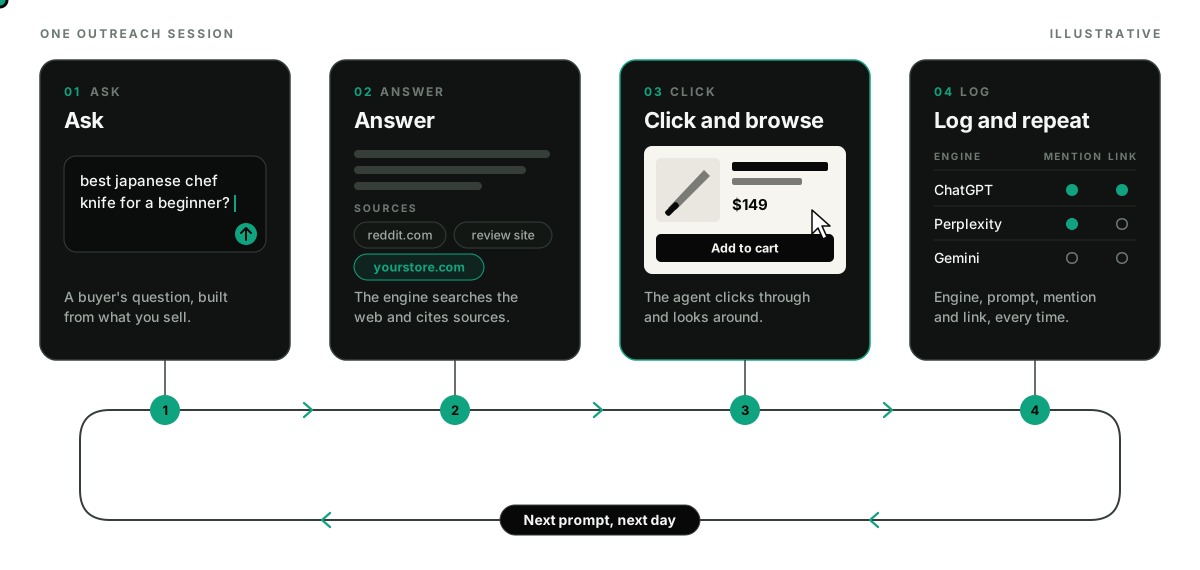
Every session follows the same pattern. Ask a question a real buyer might ask. Wait for the full answer. If your site is linked, click it and look around. Log what happened. Then do it again tomorrow with a different question, often on a different engine.
The agents are usually built on an open-source framework like OpenClaw, which can run its own browser: open tabs, type, click and read pages.5,9 At LinkGPT, agents and real people work in rotation, every day, for each business we run outreach for.
Is AI outreach the same as AI sales outreach?
No. Same words, different job.
| AI sales outreach | Automated AI outreach | |
|---|---|---|
| Who you reach | Prospects' inboxes and DMs | AI engines: ChatGPT, Perplexity, Gemini, Claude, Grok |
| What gets sent | Cold emails written by AI | Customer-style questions about your business and category |
| What you want | A reply and a booked call | To be known, described correctly and recommended |
| How you measure it | Reply rate, meetings booked | Mention rate, citations, AI referral visits |
If you came here for a cold email tool, this isn't that. If you want ChatGPT to start naming your business, keep reading.
How do AI search engines decide who to recommend?
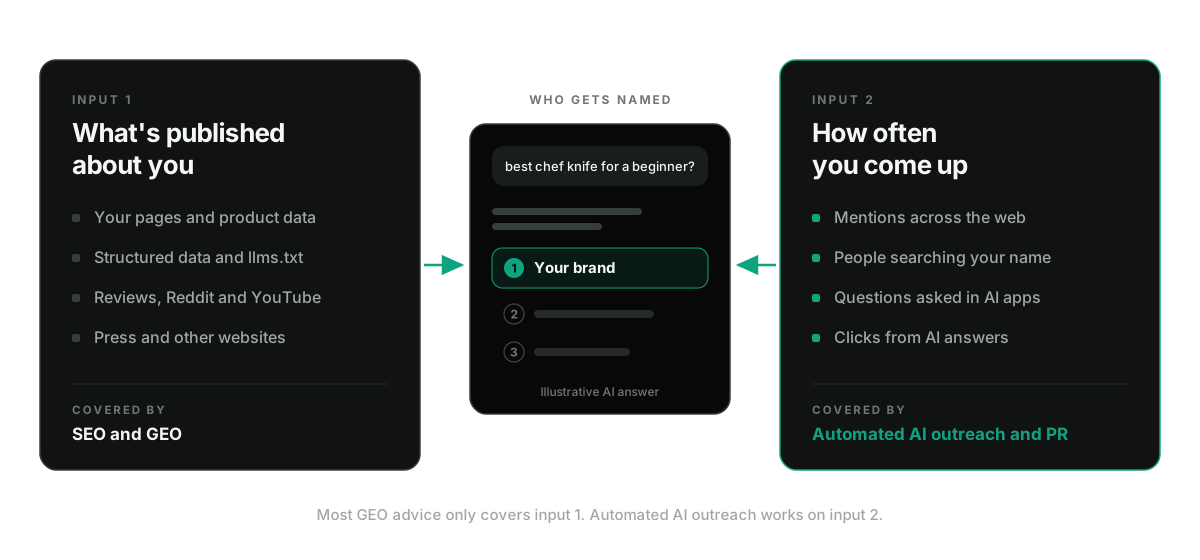
Two things decide whether an AI assistant names you.
1. What's published about you. Your pages, product data, structured data, reviews, Reddit threads, YouTube videos and press. When ChatGPT or Perplexity runs a web search to answer a question, this is what they find and cite. It's classic SEO plus GEO, and it's what nearly every guide on ranking in AI search focuses on.
2. How often you come up. How much people talk about you, search for you and ask about you. Most brands never think about this input, but the best public data we have points straight at it. Ahrefs looked at 75,000 brands and found that branded web mentions had the strongest link to showing up in Google's AI Overviews, far ahead of backlinks.2
Branded search volume is worth a second look. It's a pure demand signal: people typing your name. It beat backlinks too.
What the Clawdbot story shows
I watched the second input play out in real time in January 2026.
An open-source AI agent called Clawdbot went viral almost overnight. It has since been renamed twice and is now OpenClaw.5 In the first days, asking ChatGPT about it triggered a live web search. The answer was pieced together from forum posts in a few seconds, and it was thin.
A couple of weeks later, the same question got a fast, detailed answer, often without running a search at all.
The project was only a few months old. What changed in those weeks was demand. A huge number of people were asking about it, posting about it and clicking through to it, and the platforms caught up.
What is prompt signal indexing?
Prompt signal indexing (PSI) is the concept behind all of this: AI platforms decide what to learn, keep fresh and serve quickly based on what their users ask about. When lots of people ask about a business, the platform has a reason to know that business well.
It builds on how search has worked for years. Here's the evidence behind it:
| Evidence | Claim |
|---|---|
| Confirmed in federal court | Google ranks results partly by remembering which pages users click for which queries. Its NavBoost system runs on 13 months of click-and-query data.3 |
| Documented by OpenAI | ChatGPT conversations can be used to train OpenAI's models unless the user opts out.4 |
| Documented by OpenAI | API inputs and outputs are not used for training by default.4 |
| Documented by OpenAI | ChatGPT visits web pages live when a user asks a question, using the ChatGPT-User agent.6 |
| Visible in your analytics | Links clicked in ChatGPT reach your site tagged utm_source=chatgpt.com.7 |
| LinkGPT's model, based on what we see in practice | AI platforms learn faster about, and recommend more often, the businesses their users ask about. |
Search engines have learned from user behavior for two decades. In the same trial, Google's search leaders testified that query and click data still matter even with large AI models in the mix.3 Automated AI outreach is built on the idea that AI engines work the same way. Run it steadily and track your mention rate every week to see it move.
How does automated AI outreach work?
Here's one session, step by step. It's the same flow you see in the screen recording in the video.
- Pick a prompt. The agent starts from a prompt set built from what you sell: branded questions ("what does [your store] sell?"), category questions ("best carbon steel chef knife for a home cook") and comparisons. Prompts rotate, so no two days look the same.
- Open a live session. The agent opens ChatGPT, Perplexity, Gemini, Claude or Grok in a real browser. Same interface your customers use.
- Ask, then wait. It sends the prompt and waits for the complete answer, including any web search and source links.
- Click your link. If your site shows up in the answer, the agent clicks it.
- Browse like a shopper. On your site it scrolls, reads and opens a product page. A two-second bounce tells nobody anything.
- Log and repeat. The session gets logged: engine, prompt, mentioned or not, linked or not. Tomorrow, a new prompt.
Why live sessions instead of the API?
Because the platforms treat them differently.
An API call goes straight to the model. OpenAI doesn't use API inputs or outputs for training by default.4 There's no ChatGPT interface, often no web search, no source cards and nothing to click.
A live session runs through the actual product. Same search step, same citations, same links your customers see. And consumer ChatGPT conversations can be used to improve OpenAI's models unless the user turns that off.4
If you want to be part of the conversations real customers have, the API is the wrong door.
How do you rank higher on AI search engines?
There's no position one in AI search. There's being named for the prompts that matter to you, on the engines your customers use. If you want to see where you stand today, start with how to check your AI search ranking.
These six layers get you there. Outreach comes last because it works best when everything under it is already in place.
| Layer | What it tells AI engines | Where to start |
|---|---|---|
| 1. Crawler access | You can be read | Allow OAI-SearchBot, PerplexityBot, ClaudeBot and Googlebot in robots.txt. Sites that block OAI-SearchBot won't appear in ChatGPT search answers.6 |
| 2. Quotable pages | You have the answer | Lead with the answer. Add real numbers, specs and FAQs. In Princeton's GEO study, adding statistics, quotes and citations lifted visibility in AI answers by up to 40%.8 |
| 3. Structured data | Here are the facts | Product, Organization and FAQ JSON-LD, plus an llms.txt file |
| 4. Fast indexing | Something changed | Submit new and updated URLs through IndexNow, so participating search engines hear about changes as soon as you publish |
| 5. Third-party mentions | Other people trust you | Reddit, YouTube, reviews, press and creators. See how to build an AI-visible brand |
| 6. Automated AI outreach | People are asking about you | Agents ask about your business in live sessions every day and click through |
Layers 1 to 4 make you findable. Layers 5 and 6 give the engines a reason to pick you.
Can you build your own AI outreach agent?
Yes. OpenClaw is free and open source, and it can drive its own browser profile.5,9 Give it a list of prompts and a schedule, point it at ChatGPT, and you have the core of an outreach agent in an afternoon.
Keeping it useful is the hard part:
- Prompts. You need a fresh set per product and category, written the way buyers actually ask, and rotated so sessions don't repeat.
- Five interfaces. ChatGPT, Perplexity, Gemini, Claude and Grok all look different, and they change their layouts often. Agents break when they do.
- Babysitting. Pop-ups, logouts and verification checks stop agents mid-session. Someone has to notice.
- Logging. Without a record of every prompt, answer and click, you can't tell whether anything is working.
- Pacing. Varied, specific questions spread through the day beat volume. Asking one prompt a hundred times is noise.
If that sounds like a part-time job, it is. That's why we built it into LinkGPT.
How do you know if AI outreach is working?
Measure the same three levels you'd measure for any AI visibility work:
- Mentions. Run a fixed prompt set across all five engines every week. Track your mention rate per engine.
- Citations. Note which of your pages get linked, and which competitor pages win instead.
- Referrals. Watch AI referral sessions and, more importantly, orders from them. In GA4 or Shopify Analytics, look for
chatgpt.com,perplexity.ai,gemini.google.com,claude.aiandgrok.com.
Take a baseline before you start, then compare over four to twelve weeks. Answers vary a lot from run to run, so watch the trend, not one result. The AI visibility audit guide walks through the scoring.
What to watch
The clearest signals are mention rate per engine and orders from AI referrals. Track both weekly against your baseline.
Automated AI outreach with LinkGPT
For Shopify stores
LinkGPT runs automated AI outreach as part of the Shopify app. Agents and real people work in rotation, asking AI engines about your store and the products you sell, every day. You choose which engines get outreach.
It sits on top of the rest of the stack, all handled for you: llms.txt, product JSON-LD, IndexNow submissions and an AI Profile with a backlink to your store. Prompt tracking across ChatGPT, Claude, Perplexity, Gemini and Grok then shows you whether your mention rate is moving.
For websites and creators
Not on Shopify? LinkGPT runs the same outreach for websites and creators, built around your AI Profile: the posts, pages, products and videos you already publish, gathered into one source AI engines can read and cite. Start with your website.
Frequently asked questions
What is automated AI outreach?
Automated AI outreach is the use of software agents to ask AI assistants like ChatGPT, Perplexity, Gemini, Claude and Grok about a business on a regular schedule, in live sessions, and to click through to that business's site when it's linked. The aim is to keep the brand present in the conversations these platforms see, so they recognize it, describe it accurately and recommend it more often.
Is AI outreach the same as AI cold email outreach?
No. AI sales outreach uses AI to write and send cold emails and DMs to prospects. Automated AI outreach is aimed at the AI engines themselves. One fills an inbox. The other works on whether ChatGPT names you when a buyer asks.
Can I rank #1 on ChatGPT?
Not the way you rank #1 on Google. ChatGPT has no fixed results page, and the same prompt can return different brands for different people. What you can do is own specific prompts: be the brand it names, near the top, for the questions that describe your core product. Track your mention rate on those prompts and work to raise it.
How long does automated AI outreach take to work?
It depends on your category and engine. Take a baseline first, then run outreach steadily and compare your mention rate across engines over four to six weeks. Results vary by engine, by category and by how strong the rest of your AI visibility work is.
What is OpenClaw?
OpenClaw is a free, open-source AI agent that runs on your own machine and connects to models like Claude or GPT. It first shipped in late 2025, went viral as Clawdbot in January 2026 and was renamed OpenClaw at the end of that month. It can control a dedicated browser, which makes it a common base for outreach agents.
Is automated AI outreach spam?
It shouldn't be. Good outreach asks the kind of questions real buyers ask about a real business, and visits real pages. It doesn't post fake reviews, invent claims or flood a platform with thousands of identical prompts. Keep the facts true, the questions varied and the volume modest.
Sources
- Engadget, "OpenAI Dev Day 2026: Live updates on the latest ChatGPT and Codex announcements": ChatGPT at 1.2 billion weekly users, September 29, 2026.
- Ahrefs, "An Analysis of AI Overview Brand Visibility Factors (75K Brands Studied)": branded web mentions correlate 0.664 with AI Overview visibility, branded search volume 0.392, backlinks 0.218.
- U.S. District Court for the District of Columbia, United States v. Google LLC, Memorandum Opinion (Aug. 5, 2024): NavBoost pairs queries and documents by memorizing user click data and runs on 13 months of click-and-query data; testimony that AI models don't replace query click information.
- OpenAI Help Center, "How your data is used to improve model performance": content from ChatGPT may be used to train models unless users opt out; API inputs and outputs aren't used by default.
- Wikipedia, "OpenClaw": naming history (Clawdbot, Moltbot, OpenClaw), creator, and viral growth in January 2026.
- OpenAI, "Overview of OpenAI Crawlers": sites opted out of OAI-SearchBot won't be shown in ChatGPT search answers; ChatGPT-User visits pages when users ask questions.
- SearchPilot, "How does AI traffic show up in analytics?": ChatGPT appends
utm_source=chatgpt.comto cited links. - Aggarwal et al., "GEO: Generative Engine Optimization", KDD 2024: adding statistics, quotations and citations improved visibility in generative engine responses by up to 40%.
- OpenClaw Docs, "Browser (OpenClaw-managed)": the agent runs a dedicated browser profile and can open tabs, click, type and read pages.
Build a brand AI can understand
Connect your products, content and brand signals so AI can make sense of your store.

A Shopify merchant’s guide to GEO
Crawler access, structured data and content that gives AI a clear source to cite.
How to check your AI search ranking
Score mentions, citations and referrals across five AI engines, then fix what's missing.